


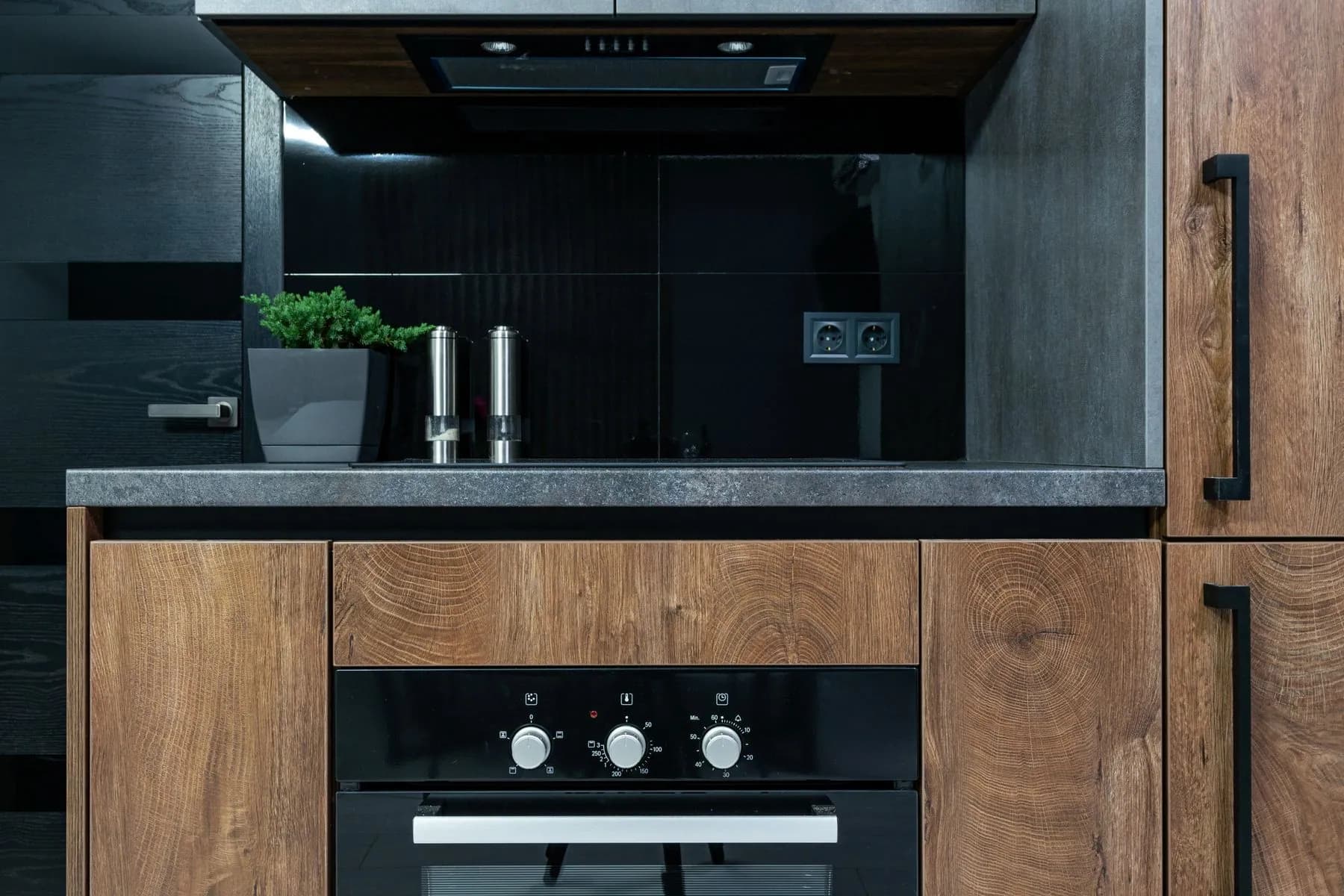
Care & warranty
Look after it properly and it will outlast the trends.
- Everyday clean
- Warm water, mild soap, dry cloth
- Never use
- Ammonia, bleach, abrasives, steam
- Indoor humidity
- 35 to 45 per cent, year-round
- Warranty term
- Stated in your agreement
A soft cloth, warm water, and the habit of drying afterwards.
The routine that keeps cabinetry looking new is dull. A soft cloth, warm water, a drop of dish soap, and drying the surface rather than letting it air off. That is the whole method for every finish in the house, and the variations below are mostly about what to avoid rather than what to add.
Wipe spills as they happen, particularly anything acidic, alkaline or strongly coloured — lemon juice, wine, turmeric, oven cleaner overspray. Then pay attention to the places water hides: the edge under a sink door, the front of the drawer beside the dishwasher, the toe kick where a mop lives. Water sitting along a joint for a day does more damage than a year of ordinary use.
- Daily
- Wipe visible spills as they happen, then dry the surface.
- Weekly
- Warm water, a drop of mild dish soap, a soft cloth — and a dry cloth behind it.
- Around the sink
- Check the underside of the door and the cabinet floor for standing water. Prefinished birch is sealed on both faces, so a wipe is enough, but nothing likes sitting wet.
- Cloths
- Microfibre or cotton. Nothing with a scouring face, ever.
Painted
Warm water with a drop of dish soap on a soft cloth, then dry immediately with a second cloth. Grease near the range lifts with an equal mix of warm water and white vinegar used sparingly and wiped dry. Nothing solvent, nothing abrasive, and no melamine foam eraser — it is a very fine abrasive and it burnishes the sheen in a patch that cannot be un-burnished.
Stained wood
The same routine, always wiping along the grain rather than across it. Once or twice a year a wood-safe conditioner on the doors nearest the range keeps the finish even. Avoid oil soaps and silicone polishes: both build a film that traps grime and makes any later touch-up or refinishing considerably harder.
Veneer
Treat it as a very thin piece of real wood, because that is what it is. Damp cloth only, never a soaking one, and dry it straight away — water standing at an edge is the one thing that can lift a veneer or an edgeband. No abrasive pads at all, since sanding through the face cannot be undone.
Thermofoil
A vinyl film heat-wrapped over a substrate, so the enemy here is heat rather than chemistry. Keep toasters, kettles and air fryers out from under wall cabinets, and never let an oven or dishwasher vent onto a door — a heat deflector strip above the oven is worth fitting. Clean with warm soapy water, dry it, and skip anything solvent.
High gloss
The marks are usually on the finish rather than in it. Use two microfibre cloths, one barely damp and one dry, and work in straight passes rather than circles — circular wiping is what leaves the swirl you notice in side light. Nothing gritty ever, including the crumbs already on the cloth.
Six things that damage cabinetry faster than a family does.
Ammonia and glass cleaner
Dulls and clouds a catalyzed finish and softens some sealers. It is the active ingredient in most blue spray cleaners, which is why they should never come near a door.
Bleach and bleach wipes
Pulls colour out of stain and can blotch a painted finish. Over time it also degrades the adhesive holding an edgeband.
Abrasive pads and powders
Scouring pads, cream cleansers and melamine foam erasers all cut the surface. On gloss and on paint the burnished patch they leave is permanent.
Steam
Steam mops and handheld steamers drive moisture into joints and lift thermofoil and veneer edges. Nothing that makes steam should be pointed at cabinetry, including a kettle under a wall cabinet.
Solvents and oil soaps
Acetone, mineral spirits, nail polish remover and citrus solvents attack the finish itself. Oil soaps leave a film that grime sticks to, and that film has to be stripped before anything can be refinished.
Water left in place
A damp tea towel hung over a drawer front will mark it, and so will a bath mat leaning against a vanity plinth. Move them, and dry the toe kick after mopping.
Wood moves. An Ontario winter makes it move twice.
Wood is not inert. It takes moisture out of the air and gives it back, and the air in a Canadian house changes character twice a year — humid through July, then very dry from the day the furnace takes over until spring.
That swing causes almost every seasonal complaint we hear. A fine line appearing where a panel meets a rail on a painted door. A drawer that ran perfectly in August catching very slightly in February. A solid wood island top with a joint you can feel in March and cannot find in July. None of it is a fault and none of it is permanent. Panels in a well-built door are deliberately left free to move inside the frame for exactly this reason, and a painted joint will open a fraction and close again on the same cycle every year.
What you can control is the size of the swing. Hold indoor relative humidity between roughly 35 and 45 per cent all year — a humidifier on the furnace through winter, air conditioning or a dehumidifier in the basement through summer. Run the range hood and the bathroom fan; both do more for the cabinetry than they do for the air. And give new cabinetry a settling period, particularly in a house that has just been renovated, because fresh plaster, screed and paint put a remarkable amount of water into the air for the first few weeks.
- Target humidity
- 35 to 45 per cent relative, all year round.
- Winter
- Furnace humidifier on. Dry air is harder on cabinetry than damp air ever is.
- Summer
- Dehumidify lower levels — basement bars, laundry rooms and below-grade wardrobes first.
- Ventilation
- Range hood ducted outside, bathroom fan run for twenty minutes after a shower.
- Expect
- Fine lines at painted panel joints in winter, and slight seasonal change in door alignment.


A door that has drifted is a one-minute job.
Doors drift. Floors settle, a house moves through its first heating season, and a hundred openings a week add up. A European hinge is designed for exactly this and comes back into line with a Phillips screwdriver — no parts, no visit.
Work on one door at a time and turn screws a quarter turn at a time, closing the door to check after each. The three adjustments are independent of one another: side to side sets the gap against the neighbouring door, depth pulls the door in toward the box or pushes it out, and height moves the whole door on its mounting plate. Doors are usually adjusted in that order, and the aim is always the same gap top and bottom, matching the doors either side of it.
- Side to side
- The front screw on the hinge arm, nearest the door. Turn it to close or open the gap against the door beside it, and move both hinges by the same amount to keep the door parallel.
- Depth
- The rear screw, or the cam on the mounting plate. Use it when a door sits proud of its neighbour or presses too hard on the bumper.
- Height
- The screws holding the mounting plate to the cabinet side. Loosen slightly, move the door, retighten.
- Drawer fronts
- Undermount runners adjust at the front clips for height and tilt, and at a small side cam for left-to-right position.
- Soft close
- If a door starts to slam, the damper has usually been switched off or has collected grease. Wipe the hinge body with a dry cloth and check the switch before anything else.
- When to call us
- A door that will not come into line, a runner that binds or rattles, a hinge plate that has pulled against the cabinet side. That is ours to put right — please don't force it.
Quartz is not indestructible. Heat is how it fails.
Countertops are the surface people are least careful with and most disappointed by, largely because the word indestructible got attached to engineered quartz somewhere along the way and it is untrue in the one way that matters most.
Engineered quartz is roughly ninety per cent ground stone bound in a polymer resin. The resin is what makes it non-porous and stain-resistant, and it is also what a hot pan destroys: a pot straight off the burner can scorch or craze the surface in seconds, and thermal shock damage cannot be polished out. Use trivets without exception, including under slow cookers and air fryers, which sit in one place radiating heat for hours. Clean with warm soapy water, and keep bleach, oven cleaner, drain cleaner and anything strongly alkaline away from it.
Natural stone behaves differently. Granite and marble are porous and want sealing, usually once a year, and the test is simple: leave a small pool of water on the surface for fifteen minutes, and if the stone darkens underneath it is time to reseal. Marble and other calcium-based stones also etch — a dull mark where lemon, wine, vinegar or a tomato sat, which is a chemical reaction rather than a stain and will happen regardless of sealer. Honed finishes hide etching far better than polished ones. Porcelain is the most forgiving of the three for heat and staining, but it can chip at an exposed edge, so treat the corners with some respect.
- Heat
- Trivets on quartz without exception, slow cookers and air fryers included.
- Cutting
- A board, every time. Stone wins against a knife and you lose the knife.
- Sealing
- Natural stone yearly. Test it by leaving a small pool of water for fifteen minutes.
- Etching
- Marble etches with acid. A honed finish hides it well; a polished one shows every mark.
- Cleaners
- Warm soapy water or a pH-neutral stone cleaner. No bleach, no oven cleaner, no abrasive.
- Sink edges
- Dry the seam at an undermount sink. Standing water finds the silicone eventually.

What the cover is made of.
Every project carries a written warranty, and the exact terms — what is covered, for how long, and what is asked of you — are set out in the agreement for your project.
What follows is the shape of it, so you know what to look for when you read yours. We would far rather explain this before you sign than argue about it afterwards. If any clause is unclear, call and we will go through it line by line.
Cabinetry construction
The boxes, joinery, doors and drawer fronts we build are warranted against defects in materials and workmanship, for the term stated in your agreement.
Installation workmanship
The fitting itself — level, plumb, secure, aligned, properly fixed to the structure — is warranted by us for the term stated in your agreement.
Hardware and mechanisms
Hinges, runners, lift systems and pull-out gear carry the manufacturer's own warranty, which on the lines we specify is generally long and generous under normal domestic use. We make the claim on your behalf rather than sending you to a supplier.
Finishes
Covered against manufacturing defect — a failure of adhesion, coverage or curing. Not covered against wear, which means knocks, scratches, heat damage, sun fading and the effects of an unsuitable cleaning product.
Countertops and appliances
Covered by their own manufacturers. We hand the documentation over at completion and help you make a claim if you ever need to.
Natural variation
Differences of grain, figure and colour between doors, and between a door and the sample you chose from, are inherent in real wood and natural stone. They are a property of the material rather than a defect, and they are excluded on that basis.
Outside the cover
Moisture damage, humidity held well outside a normal range, misuse, accidents, and any alteration or repair carried out by others after handover.
The term
Stated in your written agreement, because it varies with the scope and specification of each project. Ask your consultant to point to the clause before you sign, or call us any time afterwards and we will read it through with you.
Call us. That is the whole procedure.
Photographs help enormously before we come: one of the whole run so we can see the piece in context, one close up of the concern, and one taken at an angle in daylight, because finish issues are often invisible straight on. Tell us roughly when you first noticed it and whether anything in the room changed — a new appliance, a leak, a season.
- Call
- (365) 323-9000
- yourstyle@liv-instyle.ca
- Include
- Your address, roughly when the work was completed, and two or three photographs.
- Response
- We reply within one business day and arrange a time to come and look.
The five we are asked most.
Right away, gently. The finish is fully cured before it leaves the shop, so warm water, mild soap and a dry cloth are fine from the first day. What we would avoid in the first month is any strong degreaser near new paintwork, and letting water sit along a joint while the room is still settling after the work.
No, and it is worth knowing why. A door panel is deliberately left free to move inside its frame, because a panel locked in place would eventually split. Through a dry Ontario winter the panel shrinks a fraction and a fine line can appear where it meets the rail, then close again in the summer. That is the door working as designed. A joint that opens far enough to catch a fingernail, or a finish that flakes rather than lines, is something different — call us about those.
Usually yes, in about a minute. The hinges we specify adjust in three directions with a Phillips screwdriver: side to side on the front screw, depth on the rear screw or the plate cam, and height at the mounting plate screws. Turn a quarter turn at a time and close the door to check between adjustments. If it will not come into line, or a hinge plate has pulled against the cabinet side, stop there and call us.
Wear and accidents rather than manufacture: knocks, scratches, heat marks, sun fading, and damage caused by moisture or by a cleaning product that was not suitable for the finish. Natural variation in wood grain and colour is also excluded, because it is a property of real timber rather than a fault. Alterations or repairs carried out by others after handover end the cover on the parts affected. The full list is set out in your agreement.
The term is stated in the written agreement for your project, because it depends on the scope and specification rather than being one number for every job. Hardware carries its manufacturer's own term in addition to that. Ask your consultant to walk you through the clause before you sign, or call us at any point afterwards and we will go through it with you line by line.
Planning the next room?
The same consultant who looked after the first project can plan the next one. Door styles, colour and finish samples, hardware and design ideas come to your table, and you keep the computerized design and the detailed estimate — free, with no obligation.